

Energy and Brexit: What Are The Facts? Part 2
Energy in the UK means Gas and Electricity. In order to understand how world events (and Brexit) could affect the energy industry and ultimately your business energy costs, we need to understand where our energy come from. Gas and Electricity are different so we first have to look at them separately.
Nearly 53% of the UK’s Gas consumption is imported. Of this around 12% of gas we use annually in the UK comes from directly from the EU but we also import gas from Norway and buy gas in liquid form, which arrives by ship, mainly from Qatar, but also Algeria, Dominican Republic, Nigeria, Norway, Peru, Trinidad & Tobago, USA and last but not least, Russia. The remaining nearly 47% is domestically produced, mainly from the North Sea and Scotland.


Electricity is a bit more complicated. Not only do we need to look at what is directly imported by way of ‘interconnectors’ (more information below) but how electricity is generated. This direct method of importing electricity is widely reported as the headline “5% from the EU” but this doesn’t tell the whole story. The UK interconnectors with mainland Europe in France, Belgium, The Netherlands and Ireland. Northern Ireland has three interconnectors with the Republic and one with Scotland. More interconnectors are being built to Norway and Denmark. Trade via these could be less efficient and more expensive after Brexit if there is no agreement in place.

The chart below shows the increasing use of renewables and the sharp decline in the use of coal since 2012. Whilst this trend is expected to continue, Natural Gas is still the biggest contributor to the National Grid.
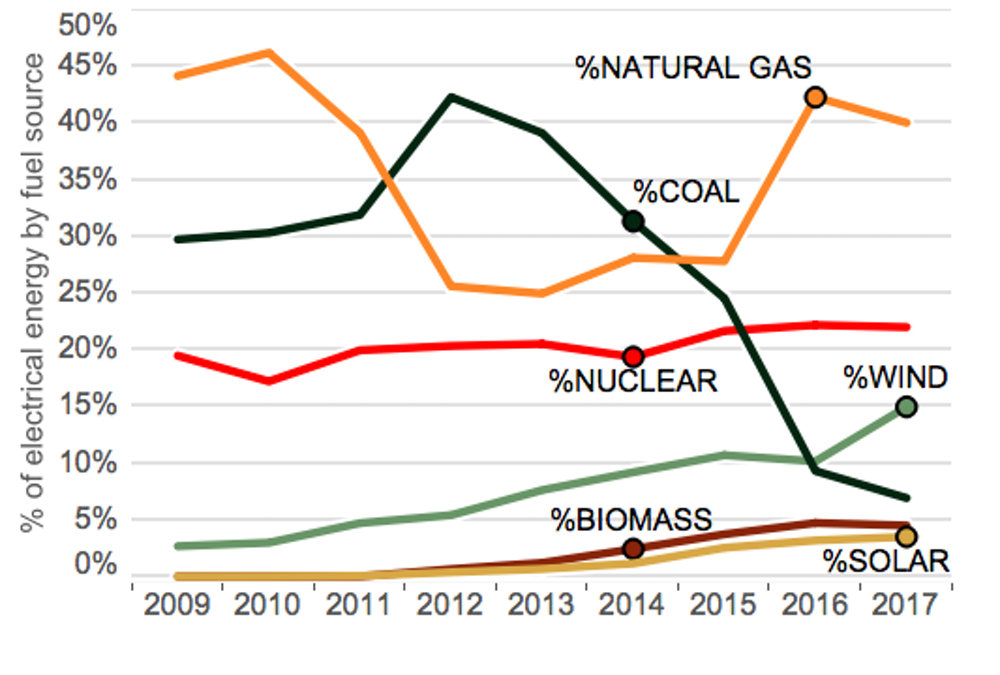
As shown above, 53% of the UK’s gas is imported. This accounts then for nearly 22% of total electricity production. Biomass accounts for nearly 5% of total generation. 97% of these pellets are imported, the vast majority (58% total) are shipped from the USA and Canada (21% total). Interestingly, the UK is Europe’s largest consumer of imported wood pellets by a very large margin.
Nuclear accounts for roughly 20% of total generation. Whilst the UK generation market is government controlled, all UK nuclear sites are owned and operated by EDF, a division of the French state owned supplier.
Coal still accounts for 7.6% of total generation and over 85% of coal used for electricity production is imported from Colombia, Russia, USA and Australia in that order. This equates to 6.46% of total generation.
Add all these percentages up and we come to the grand total of 58% of UK electricity generation reliant on imports or foreign ownership.
Adding all this information for gas and electricity production together, 55% of the UK’s total energy consumption is reliant on imports or foreign ownership. With Brexit looming on the horizon and all the uncertainty this will cause prices to fluctuate at best. Add to this the major part the US plays in our energy security and you can see how prices can be influenced by a mis-timed ‘tweet’ or a badly handled negotiation.
Our advice?
Lock in your next energy deal for as long as you can and ride out the for-casted storm for as long as possible. All of this doom and gloom is on the back of a 143% rise in wholesale costs from 2007 to 2017. Locking in your energy prices removes the worry and gives you some peace of mind for the two, three, four or more years you can contract for.
If you still have many months to run on your current contract, any commercial broker worth their salt should be able to offer future priced contracts where your start date can be from 6 months to 5 years in the future dependent on supplier and availability.
It is entirely up to you. If you consider your business energy costs to be manageable, a small proportion of your business expenses then that’s great, but we are already seeing at 25% to 30% increases by way of renewal offers from contracts coming to an end in the next couple of months. We are routinely reducing these increases but we are expecting this to be increasingly difficult as ‘B-Day’ looms. If your business is a large consumer or energy accounts for a large proportion of your costs, can you afford a 20%, 30% or even higher increase in the coming months and years?
Just playing devils advocate here though, the entire UK economy accounts for just 6% of the global economy. In the bigger picture, what difference does it make really? If you can ride out the bumps it’ll be OK in the end. Hopefully.
[email-subscribers-form id="1"] |